
📕How Xiaohongshu Becomes the Hub for AI Discussios in China
The app known for makeup tutorial now has more AI posts than lipstick posts.

Remember Xiaohongshu, or Little Red Book/Red Note, the Chinese social media app that briefly became the U.S.’ top download during the TikTok refugee crisis earlier this year?
The platform known for makeup tutorials and travel tips became the unlikely gathering place for China’s AI elite and enthusiasts. Since this September, “Ask Me Anything (AMA)”, a type of online open forum that first went viral on Reddit and Twitter/X, has exploded across the app and reportedly generated over 120 million views.
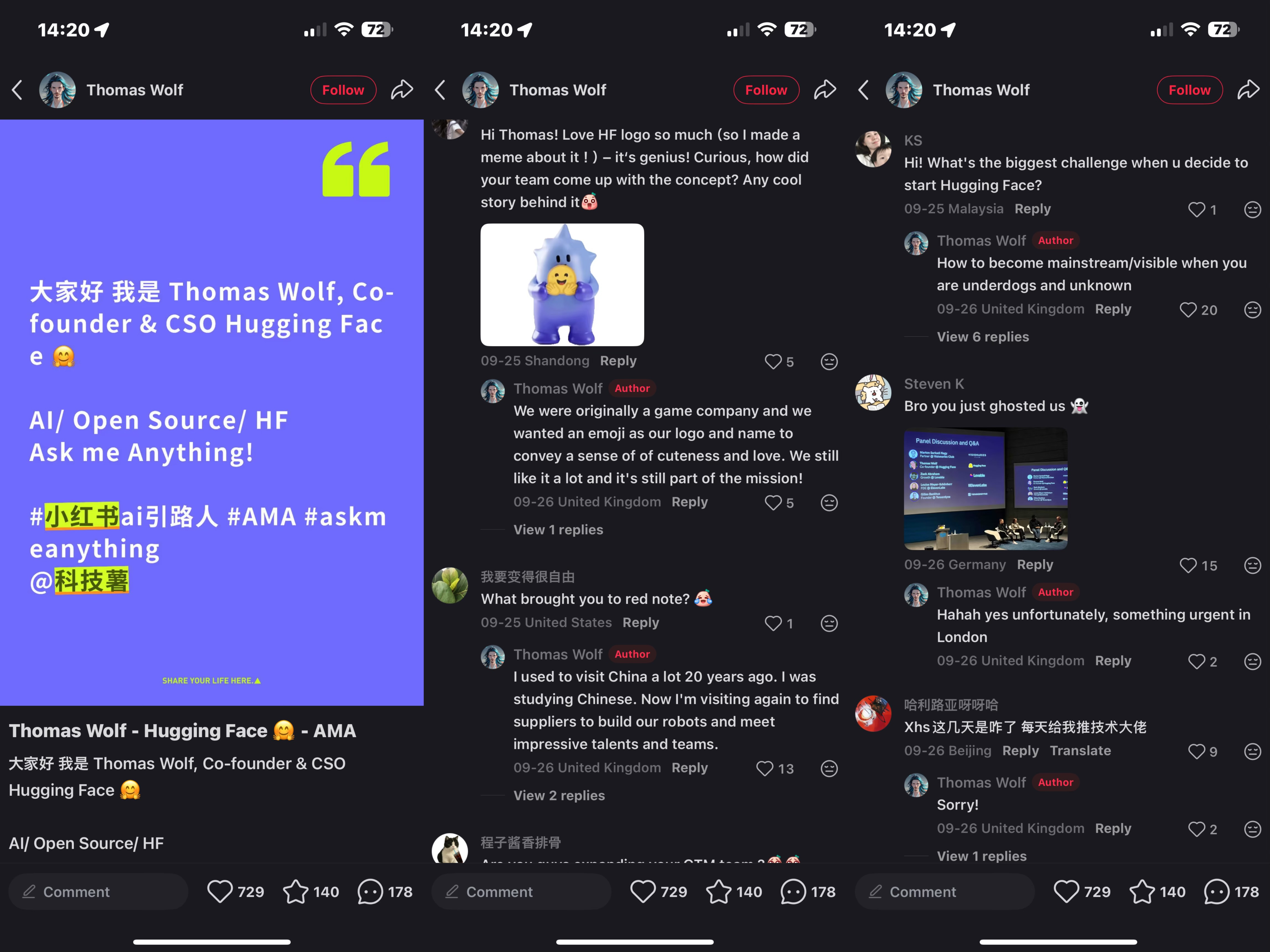
We’re talking serious names: Kai-Fu Lee of 01.AI, Zhiyuan Liu from Tsinghua University and ModelBeast, Megvii founder Qi Yin, and researchers from Alibaba’s Qwen, Tencent’s Hunyuan, and Moonshot AI’s Kimi. Even Thomas Wolf, co-founder of HuggingFace, also joined this campaign.
Translated to the Western context, imagine Sam Altman or Andrej Karpathy doing AMAs on Instagram instead of Twitter/X
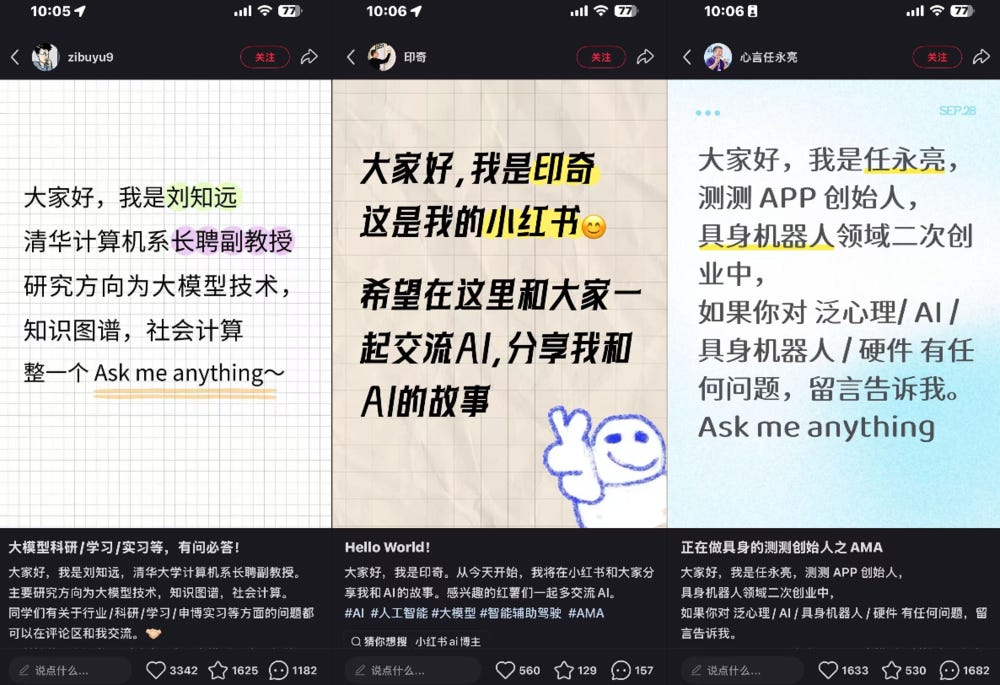
First came the academics. They released AMA posts and engaged in comment sections, answering questions ranging from their thoughts on AI and LLMs to graduate student advices. This then drew tech enthusiasts, including startup founders, big tech researchers, and investors to jump on the bandwagon.
The timing wasn’t accidental. China’s AI sector is booming, yet the country lacked a public social media space where general audiences could directly engage with AI elites. For years, most practitioners shied away from sharing technical experiences around training LLMs, keeping their heads down and building in isolation. Xiaohongshu’s AMAs filled that void.
The rise of open-source LLM initiatives in China likely accelerated this shift, as the community increasingly values open discussion and experience sharing over working behind closed doors.
Now it’s spreading to a broader group: economists, securities analysts, corporate founders, recruiters, and students. The format has also spawned some playful variants, such as DAMA (Don’t Ask Me Anything), AMN (Ask Me Nothing), TDAMA (Task Me Anything). In September alone, AMA-related posts doubled month-over-month on Xiaohongshu, according to official statistics.
What makes this remarkable is Xiaohongshu was originally a platform built on lifestyle content, but is outshining apps such as Weibo and Zhihu, China’s Twitter and Quora equvalent respectively.
Xiaohongshu’s community teams should definitely take the credit. They spotted the early trend and quickly expanded it by invitng academics from elite universities to join AMAs. Once those sessions gained traction, they provided operational support such as promoting posts, connecting participants while letting the community drive the conversation. The strategy worked.
Why Were They There to Begin With
The AMA explosion is merely the reflection of something that’s been building for years. Chinese media outlet Guixingren reported that searching “AI” last year on Xiaohongshu yields 16.15 million posts—surpassing “makeup” (10.06 million) and “lipstick” (6.29 million). The app known for beauty influencers now hosts more AI content than cosmetics content.
The platform serves three type of users:
Chinese researchers find breaking AI news, emerging AI apps, and technical discussions, especially those from Silicon Valley. Reviews of top-tier AI conferences such as CVPR and NeurIPS also appear on Xiaohongshu first, often from the authors themselves. The platform’s origins as a “study abroad guide app” left it with heavy international IP representation, a significant advantage as AI became a global phenomenon.
Entrepreneurs discover investors, co-founders, and case studies. “Xiaohongshu users love to share,” one founder notes. “Finding people is easy. Other platforms feel like shouting into the void.”
Beginners also find AI app and tool tutorials helpful on Xiaohongshu. Before the AI wave, the platform was full of guides for career improvement. The current rush simply redirected energy from “learn to code” to “learn AI.”
The Structural Edge
Xiaohongshu’s rise in AI world also rests on three advantages competitors can’t easily replicate:
Demographics: Its 300 million monthly active users skew heavily toward first- and second-tier city professionals, with Gen Z and millennials overrepresented. They are naturally receptive to emerging technology.
Content DNA: Xiaohongshu posts have strong templating characteristics. When ChatGPT launched, users tested it by feeding it Xiaohongshu content and discovered AI could mass-produce posts matching the platform’s style. Chinese AI startups Kimi and Zhipu’s GLM models both launched agents specifically for generating Xiaohongshu content, creating a feedback loop where AI development and popularization happened on the same platform.
Recommendation Algorithm: Unlike Douyin (TikTok’s Chinese sibling), where traffic flow to the top content creators, Xiaohongshu distributes traffic more evenly. Long-tail creators also get seen. This algorithm allows niche trends to find audiences, strengthen through interaction, and attract new members. Small movements can achieve escape velocity.
For Xiaohongshu, AI content also leads to a demographic pivot. The platform has long been boxed in by its association with affluent female users. Previous attempts to attract men through sports content, hardware reviews, and automotive coverage had mixed results.
Tech discourse is a major male interest category. AI’s explosion is accelerating demographic expansion while opening new advertising inventory. LLM companies now run campaigns on Xiaohongshu, treating it as essential distribution infrastructure.
The data confirms the shift. In the first half of 2025, tech-related content on Xiaohongshu grew nearly 150% by volume, with readership up over 200%. The platform is riding multiple cultural shifts and building infrastructure to capture those movements before competitors recognize the territory is contested.
When your beauty tutorial app has more posts about AI than lipstick, something structural has shifted. The question is whether Xiaohongshu can consolidate these gains—or whether platforms like Zhihu and Bilibili will find ways to reclaim territory they assumed was theirs by default.
The early signs suggest Xiaohongshu isn’t giving it back.
Excellent analysis! What if Instagram actually became the next AI elite hub?